
Design in Pasadena
A city with more architectural history than almost any in Southern California, and a preservation framework that takes it seriously. Here, what you are allowed to change is the first question.
History is the governing constraint.
Pasadena is an independent city with its own planning department, and it is unusual in Southern California for the depth of its architectural stock - Craftsman, Spanish Colonial Revival, Mediterranean, Mid-Century - and for the seriousness of the framework protecting it.
The practical consequence for an owner is that status comes before design. The city maintains landmark designations, historic districts and landmark districts, and a great many houses carry significance that affects what may be altered, particularly at the exterior. Proposing changes to a designated property, or to a contributing property within a district, brings a review that engages with the architecture itself rather than with numerical compliance. Owners who establish their property's status before developing a brief avoid the most expensive surprise available here.
The second variable is topography. The hillside areas - Linda Vista, parts of San Rafael and the arroyo-adjacent land - carry their own development standards concerned with slope, grading and visual prominence, which are a different problem from the flat lots of the older districts. And across the whole city, mature street trees and significant private specimens are protected in ways that constrain footprints.
What governs a Pasadena remodel or addition.
These four decide what is possible on most Pasadena properties. Confirm current standards with the City of Pasadena before relying on any of them.
Establish historic status before you develop a brief
Whether a property is designated, contributes to a district, or is merely eligible changes what may be altered - especially at the street-facing exterior. The review that follows engages with materials, proportion, window pattern and how an addition reads against the original, rather than with floor area alone. Owners who find this out after the design is developed redo the design.
Additions go where they cannot be seen
On designated and contributing properties the workable strategy is almost always to put new floor area at the rear or within the existing envelope, subordinate in massing and legible as new rather than imitative. That is a genuine architectural skill, and it is the difference between an approval and a year of revisions. It is also usually the better building.
The hillside areas are a separate problem
Linda Vista, parts of San Rafael and the arroyo-adjacent land carry standards concerned with slope, grading and how a house reads from the surrounding landscape. Buildable programme on a sloped Pasadena parcel is set by terrain, as it is anywhere else in the region - but here it is combined with a design culture that scrutinises visual prominence.
Restoration detailing is specified, not improvised
Where original fabric is being repaired or matched - wood windows, shingle, plaster, tile, joinery profiles - the specification has to be right, and the drawings have to carry enough detail for a builder to execute it. We model and document this properly, because 'match existing' on a drawing is not a specification and it is where restoration projects go wrong.
Pasadena work, old and new together.
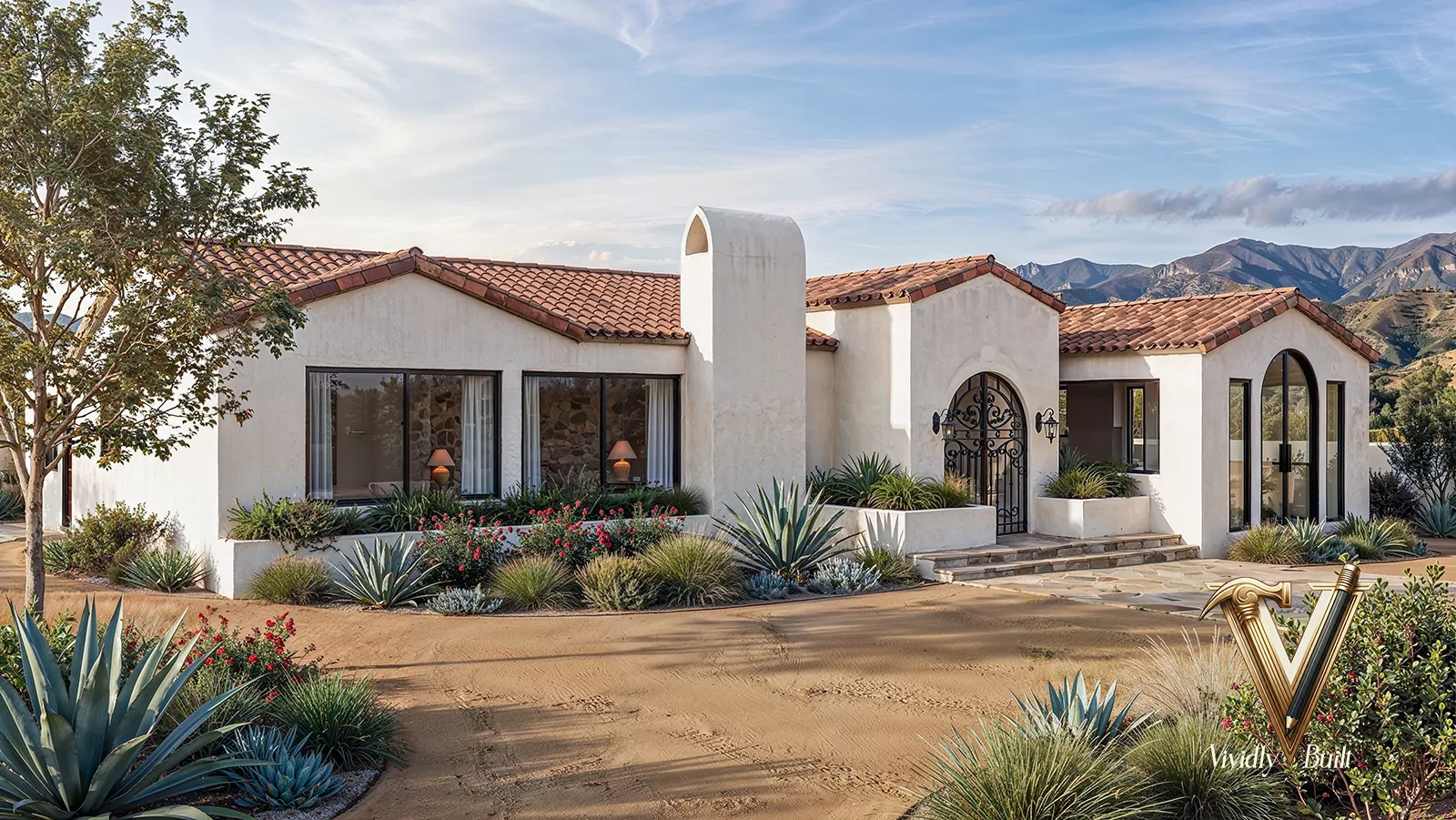
Two Pasadena projects: a Mediterranean estate taken through a full interior and exterior remodel, and a Craftsman reimagined without losing what made it worth keeping.


Where we work nearby. We design across the San Gabriel Valley and into the city - San Marino, Hollywood Hills and Beverly Hills.
What we design in Pasadena.
Vividly Built provides home design, interior design and photoreal visualization as one service, across residential and commercial categories in Pasadena and the surrounding submarket.
Common questions about designing in Pasadena.
How do I find out if my Pasadena house is historic?
The city maintains designation and district information, and a great many properties are either designated, contributing to a district, or eligible. Because status governs what may be altered at the exterior, establishing it is the first step - before a brief is written rather than after a design is developed.
Can I add a second storey to a historic house?
Sometimes, but rarely in the way owners first imagine. On designated and contributing properties, new floor area generally needs to be subordinate, set back, and legible as an addition rather than an imitation of the original. A full-width second storey on a street-facing elevation is among the least likely proposals to succeed; a well-handled rear addition is among the most.
What is the difference between a landmark and a contributing property?
A landmark is individually designated for its own significance. A contributing property is one that forms part of what makes a district significant, even if it would not be designated alone. Both bring review when alterations are proposed, though the emphasis differs. Which category applies to your address is worth confirming precisely, because it shapes the scope of what can change.
Do hillside rules apply in Pasadena?
In the hillside areas - Linda Vista, parts of San Rafael, and land adjacent to the arroyo - yes, with standards concerned with slope, grading and visual prominence. On those parcels the buildable programme is set by terrain, and the design is additionally assessed on how it reads from the surrounding landscape.
Is it worth restoring rather than replacing original features?
Frequently, and not only for approval reasons. Original wood windows, plaster, tile and joinery in the Pasadena stock are often of a quality that is expensive to reproduce and impossible to fake convincingly. Where restoration is the right call we document it properly, because 'match existing' is not a specification a builder can price or execute.
Can you work in a contemporary language here?
Yes, and good contemporary work exists across the city - particularly on non-designated properties and in the hillside areas. What does not succeed is contemporary work that ignores its context on a street where context is the point. We model the street-facing experience before anyone commits to a direction.
Do you handle the review submittals?
Yes, and we prepare them as photoreal in-context imagery rather than line drawings. A body assessing how an addition reads against an original building can judge far better from something it can actually see.
A Pasadena project, designed for what the house already is.
Send us the address. We will establish historic status and the achievable scope first, then design to it - whether that means restoration, a subordinate addition, or something frankly contemporary.